


How Long Does a Bulging Disc Take to Heal
A bulging disc typically requires anywhere from four to six weeks to several months to heal, depending heavily on the severity of the injury and the patient’s adherence to conservative treatments. While minor cases may resolve with rest and anti-inflammatory medication, persistent pain signals the need for specialized medical intervention to prevent long-term nerve damage. For comprehensive evaluation and advanced care, consulting Dr. Youssef Josephson, DO, at Comprehensive Pain Specialists ensures access to personalized treatment plans designed to accelerate recovery and safely restore spinal mobility. For more information, contact us or book an appointment online. We are located at 1177 PA-315, Dolphin Plaza, Wilkes-Barre, PA 18702.
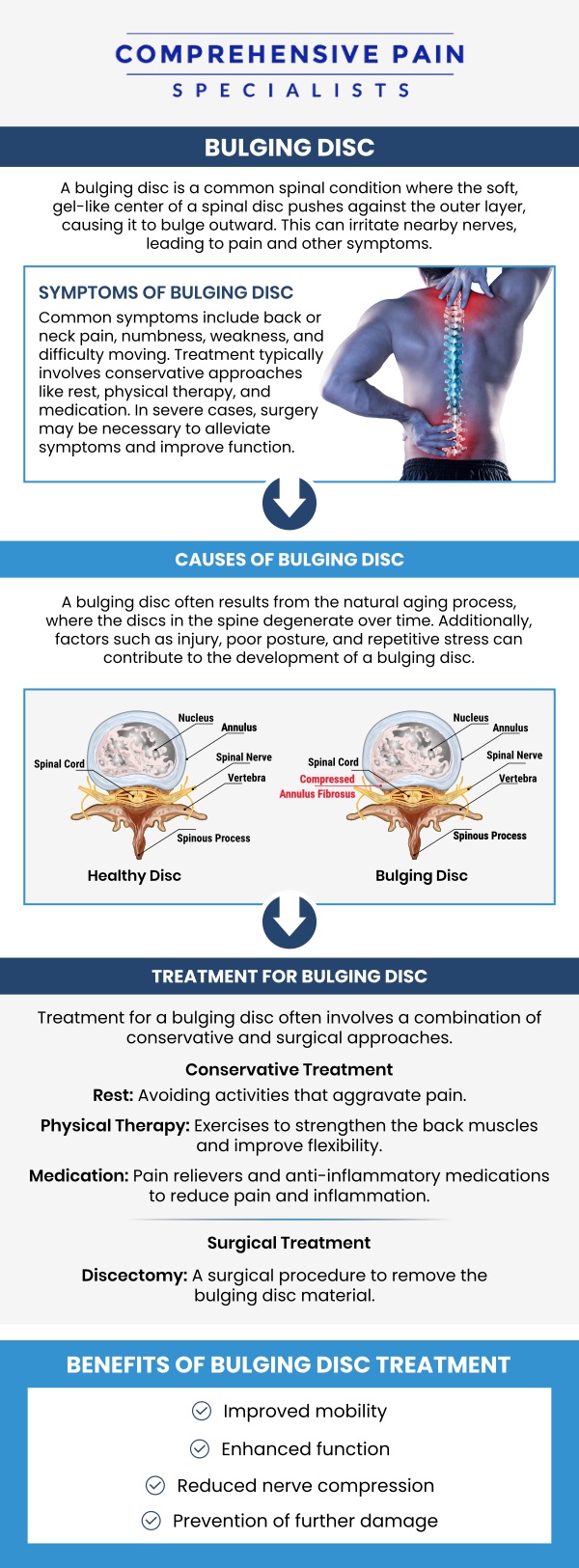
Table of Contents:
What factors can affect how quickly a bulging disc heals?
Can a bulging disc heal on its own without surgery?
What treatments can help speed up bulging disc recovery?
When should you see a doctor if a bulging disc does not improve?
How Can Dr. Youssef Josephson Support Bulging Disc Recovery?
At Comprehensive Pain Specialists, we understand that the healing time for a bulging disc can vary greatly from patient to patient. Our team is dedicated to providing individualized care, recognizing that recovery is influenced by a range of personal and medical factors.
Age and Overall Health:
Younger patients typically experience faster healing due to more resilient spinal tissues, while older adults may require a longer recovery period. Our comprehensive assessments consider your age, nutrition, smoking status, and any chronic conditions such as diabetes, all of which can impact your body’s ability to recover.
Severity, Location, and Activity Level:
The extent and location of the bulging disc play a significant role in recovery time. For example, discs in the lower back (lumbar region) often endure more mechanical stress, potentially prolonging healing. We tailor your treatment plan based on the nature of your disc condition and your activity level. We guide you in finding the right balance—encouraging movement and physical therapy to avoid muscle weakness and stiffness, while helping you steer clear of activities that may aggravate your symptoms.
Adherence to a Personalized Treatment Plan:
Following your customized treatment plan is crucial to optimal recovery. This may include physical therapy, medications, and lifestyle modifications—all coordinated by our multidisciplinary team. We support you in making necessary changes, such as improving posture or managing weight, to help reduce spinal strain and promote healing.
Addressing Underlying and Psychological Factors:
Conditions like obesity, poor posture, and even psychological stress can hinder recovery. We offer resources and support to help manage these factors, understanding that pain is both a physical and emotional experience.
Genetics and Early Intervention:
Some patients may have a genetic predisposition affecting their connective tissue and healing capacity. Regardless, early diagnosis and timely intervention—key components of our practice—are associated with better outcomes and faster recovery.
Your Recovery, Our Priority:
Every patient is unique, and so is their path to recovery. At Comprehensive Pain Specialists, we are committed to guiding you every step of the way, using the latest evidence-based treatments and compassionate care to maximize your healing and quality of life.
Many patients ask whether a bulging disc can heal without surgery. In most cases, the answer is yes. The body’s natural healing processes often allow a bulging disc to improve over time, typically within several weeks to a few months, depending on the severity and the individual’s overall health.
At Comprehensive Pain Specialists, we focus on non-surgical treatments as the first line of management. Our multidisciplinary approach may include:
• Personalized Physical Therapy: Our therapists design exercise programs to strengthen the muscles supporting your spine, relieve pressure on the affected disc, and promote healing.
• Medication Management: We may recommend anti-inflammatory medications to reduce pain and swelling.
• Lifestyle Modifications: Our team provides guidance on posture, activity modifications, and ergonomics to help prevent further injury.
• Minimally Invasive Procedures: For persistent pain, we offer treatments such as epidural steroid injections to target inflammation and provide relief.
Surgery is considered only when conservative therapies are ineffective or if there are signs of serious neurological impairment, such as worsening weakness or loss of bladder or bowel control.
If you suspect you have a bulging disc, the physicians can provide a thorough evaluation and a customized treatment plan tailored to your needs. Early intervention helps optimize recovery and reduce the risk of complications.
At Comprehensive Pain Specialists, we offer a wide range of advanced treatments to help patients recover from a bulging disc, with personalized care plans designed to address each individual’s unique symptoms and health needs.
Our experienced professionals play a crucial role in your recovery, guiding you through targeted exercises and stretches to strengthen the muscles supporting your spine, enhance flexibility, and relieve pressure on the affected disc.
Effective pain management is at the heart of our approach. Depending on your level of discomfort, we may recommend over-the-counter medications for more severe pain.
Complementary therapies, including heat or cold treatments, are available to help minimize muscle spasms and decrease inflammation. Our team will also work with you on lifestyle modifications, such as weight management and proper posture, to promote healing and reduce your risk of future disc problems.
At Comprehensive Pain Specialists, we believe in a multidisciplinary approach. When appropriate, we discuss alternative therapies as part of your overall treatment plan, always ensuring any new therapy is coordinated with your primary care provider.
Surgical options are considered only if conservative measures do not provide relief after several weeks, or if there are signs of severe nerve involvement, including significant weakness or loss of bladder or bowel control. Our specialists will guide you through every step, from initial diagnosis to advanced interventional procedures, with regular follow-ups to monitor your progress and ensure the best possible outcome.
If you have a bulging disc and your symptoms are not improving with rest, over-the-counter pain medications, or physical therapy after several weeks, it is important to consult a specialist. At Comprehensive Pain Specialists, our experienced team is dedicated to diagnosing and treating spine-related pain conditions like bulging discs.
You should seek medical attention promptly if you experience worsening pain, numbness, tingling, or weakness in your arms or legs, as these symptoms may indicate nerve involvement or increased compression. Additionally, if you notice difficulty walking, loss of coordination, or balance problems, it is crucial to be evaluated by a pain management expert.
If you develop any loss of bladder or bowel control, or numbness in the groin or inner thighs (saddle anesthesia), seek emergency medical care immediately—these symptoms may signal a serious condition called cauda equina syndrome.
At Comprehensive Pain Specialists, we offer a thorough evaluation, including advanced imaging and diagnostic techniques, to identify the root cause of your pain. Our multidisciplinary approach to treatment may include medication management, interventional pain procedures such as epidural steroid injections, and personalized rehabilitation programs. In select cases, we coordinate care with spine surgeons for surgical intervention when necessary.
The recovery time for a bulging disc varies according to its location, the degree of nerve irritation, the severity of symptoms, and the patient’s overall spinal health. Some people begin to notice less pain and greater mobility within several days or weeks, while more persistent cases may require six to twelve weeks or longer. Symptom relief does not always mean the disc has completely returned to its original shape; improvement often occurs as inflammation decreases and pressure on nearby nerves becomes less disruptive.
At Comprehensive Pain Specialists in Wilkes-Barre, Dr. Youssef Josephson, DO, evaluates each patient’s pain pattern, neurological symptoms, physical limitations, and diagnostic findings before developing a recovery plan. Depending on the condition, care may focus on reducing nerve irritation, restoring comfortable movement, and preventing activities from repeatedly aggravating the spine. Patients whose pain continues, spreads into an arm or leg, or causes numbness or weakness should seek professional evaluation rather than waiting indefinitely for the condition to improve on its own. For more information, contact us or book an appointment online. We are located at 1177 PA-315, Dolphin Plaza, Wilkes-Barre, PA 18702. We serve patients from Wilkes-Barre PA, Glen Lyon PA, Dallas PA, Pittston PA, Mountain Top PA, Plymouth PA, and surrounding areas.
Check Out Our 5 Star Reviews


Additional Services You May Need
• Back Pain
• Neck Pain
• Joint Pain
• Shoulder Pain
• Hip Pain
• Knee Pain
• Arthritis
• Osteoarthritis
• Rheumatoid Arthritis
• Fibromyalgia
• Sciatica
• Complex Regional Pain Syndrome
• Neuropathic Pain
• Nerve Pain
• Diabetic Neuropathy
• Postherpetic Neuralgia
• Myofascial Pain Syndrome
• Headaches & Migraines
• Chronic Pain
• Failed Back Surgery
• Failed Neck Surgery
• Spinal Arthritis
• Aurora Zip
• Caudal Epidural Steroid Injection
• Cervical Epidural Steroid Injection
• Cervical Facet Radiofrequency Neurotomy
• Lumbar Radiofrequency Neurotomy
• Tenotomie
• Herniated Disc
• Bulging Disc
• Degenerative Disc Disease
• Spinal Stenosis
• Facet Joint Syndrome
• Pinched Nerve
• Spondylosis
• Spondyloisthesis
• Work-Related Injury
• Sports Injury
• Whipash
• Concussion
• Car Accident Injury
• Post-Surgical Pain
• Fracture-Related Pain
• Trigeminal Neuralgia
• Phantom Limb Pain
• Sacroiliac Joint Dysfunction
• Coccydynia
• Sacroiliac Joint Steroid Injection
• Vertiflex Superion Procedure
• Viadisc
• Head Injuries
• Muscle Spasm
• Lumbar Epidural Steroid Injection
• Medial Branch Block
• Sacroiliac Joint Fusions
• Rotator Cuff Tears
• Radiofrequency Ablation
• Migraine Botox

Additional Services You May Need
• Back Pain
• Neck Pain
• Joint Pain
• Shoulder Pain
• Hip Pain
• Knee Pain
• Arthritis
• Osteoarthritis
• Rheumatoid Arthritis
• Fibromyalgia
• Sciatica
• Complex Regional Pain Syndrome
• Neuropathic Pain
• Nerve Pain
• Diabetic Neuropathy
• Postherpetic Neuralgia
• Myofascial Pain Syndrome
• Headaches & Migraines
• Degenerative/Herniated Disc
• Bulging Disc
• Degenerative Disc Disease|
• Spinal Stenosis
• Facet Joint Syndrome
• Pinched Nerve
• Spondylosis
• Spondyloisthesis
• Work-Related Injury
• Sports Injury
• Whipash
• Concussion
• Car Accident Injury
• Post-Surgical Pain
• Fracture-Related Pain
• Trigeminal Neuralgia
• Phantom Limb Pain
• Sacroiliac Joint Dysfunction
• Coccydynia
• Chronic Pain
• Failed Back Surgery
• Failed Neck Surgery
• Spinal Arthritis
• Aurora Zip
• Caudal Epidural Steroid Injection
• Cervical Epidural Steroid Injection
• Cervical Facet Radiofrequency Neurotomy
• Lumbar Radiofrequency Neurotomy
• Tenotomie
• Sacroiliac Joint Steroid Injection
• Vertiflex Superion Procedure
• Viadisc
• Head Injuries
• Muscle Spasm
• Lumbar Epidural Steroid Injection
• Medial Branch Block
• Sacroiliac Joint Fusions
• Rotator Cuff Tears
• Radiofrequency Ablation
• Migraine Botox


 Send Text
 How May I Help You?